
Journal
Which shed size do you need? Start with the ground, not the cubic feet
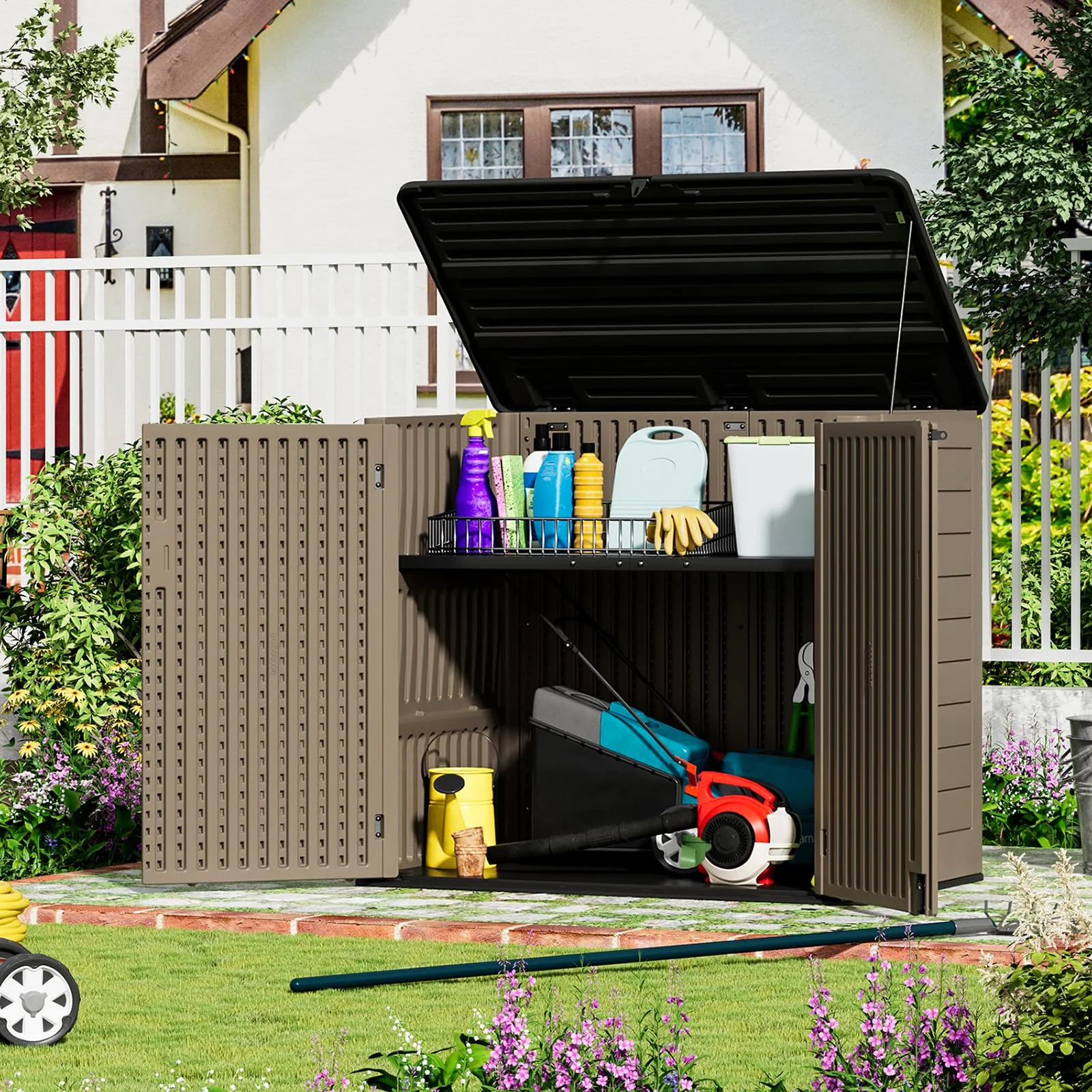
The opening mistake
The number on the page reads 48 cubic feet, and it sounds like plenty. In your head the patch beside the garage is already clear, with the cushions in, the mower in, and the two tall trash bins folded neatly behind them.
Then you push the mower down the strip and find out what the ground is: a 42 inch ribbon between the house and a planter. The 48 cubic foot box wants more width at the front than that ribbon has. The mower does not go through the opening. The bins do not stand side by side. The tidy stack you pictured has nowhere to be.
This is the mistake you can avoid. Cubic feet tells you volume. It does not tell you the shape of the object, nor the width of the door, nor how runoff from the roof will puddle the base. Measure the strip of ground the box will stand on. Measure the width along the only line of sight that will matter when you roll a mower or slide a storage bin in.
A few minutes with a tape measure beats a vague, comforting number on a product page. Start with the ground. Then check the rest. The rest is small arithmetic and choices you can make from a short list of measurements. We sell boxes across a range of shapes and materials. The right one starts where you want it to stand.
The six numbers that decide
There are six measurements that decide whether a given box will work in your space. Start with the width of the strip. If your strip is 50 inches, a box that is 51.5 inches wide will not fit without moving something else. Convert inches to feet if that helps: 51.5 inches is 4.29 feet. Fifty inches is 4.17 feet. That small difference can ruin a plan.
Next is the height under whatever is above the spot, such as an eave, a railing, or a low shelf. If the box is 70.8 inches tall, and the overhang is 66 inches, the tall box will not stand upright there. Add a few inches for clearance so doors and lids open freely.
Third, measure the tallest thing you plan to store. Bikes and folded patio umbrellas are tall. A push mower deck is usually about 22 inches across the deck, and two wheeled bins stand about 42 inches tall and need roughly a 50 inch strip. If you plan to store a mower inside, the door or lid must admit those footprints.
Fourth, the door opening matters more than the cubic feet for bulky items. Look at the box width and depth to estimate a clear opening, then compare it to the footprint of what you store. For example, a 51.5 inch wide box gives a much larger frontal opening than a 34 inch wide box.
Fifth, check where water runs after rain. Avoid the low point where runoff collects. Boxes are designed to keep contents dry, but they do not survive standing in a puddle.
Finally, check whether a metal shelf set exists for that size. Shelf sets are cut for specific capacities. When a shelf set is available, organizing becomes easier and returning the wrong size is less likely.
Do the arithmetic. Width in inches, tallest item height, clearance under eaves, and the door opening create a simple pass or fail for a candidate box. When all six numbers line up, you will have a storage solution that fits both the ground and the stuff inside.
The three size classes and what they actually swallow
Think of our range in three classes. First, the doorstep box. This is the smallest class, including compact resin boxes and deck boxes sized by gallons. Examples are the 10 cubic foot chest at 15 by 34 by 36 inches, and the 110 gallon deck box, which measures 46 inches along the front, 24 inches deep, and 24 inches high. These are good for cushions, a pool kit, garden tools, and small items. They swallow pillows and hand tools easily. They do not fit push mowers standing in, unless the mower can be angled and the lid admits the height. They will not hold two wheeled bins side by side. Bikes do not fit.
Second, the cabinet-sized shed. This group covers the mid-size boxes and taller cabinets: capacities in the range 26, 37, 48, 52, and 57 cubic feet, and outdoor cabinets that are 34 to 36 inches tall and 34 inches wide. The 37 cubic foot box measures 51.5 by 27.7 by 45.3 inches. The 48 cubic foot box is 53 by 33 by 47 inches. These sizes can hold a push mower, several patio cushions, a full pool kit, and garden tools. Two wheeled bins need about a 50 inch strip, so the 51.5 inch widths will take a single bin or possibly two aligned carefully. What does not fit here are multiple adult bicycles standing upright without removal of a wheel, and large, heavy ride-on mowers. Taller items that require standing clearance above 66 inches will not fit in these cabinets.
Third, the walk-in. These start at footprints like 6 by 4 feet and go up to 6 by 11 feet. The 6 by 4 walk-in listed measures 71 by 41.5 by 70.8 inches externally. The largest walk-in at 6 by 11 is 71 by 130.2 by 70.8 inches. These swallow lawn mowers, several bikes, a stack of firewood, and long-handled tools. They also take multiple trash cans with room to move. What they do not take well is a sloppy base. A walk-in that sits on uneven soil will have doors that bind, and heavy contents will stress the base. For walk-ins you will consider a firm, level pad.
Doors and lids, and why the opening beats cubic feet for a mower
Volume can mislead you. A large cubic foot number does not tell you whether a mower, a trash bin, or a bike will pass through the opening. There are two common access types: a front door or a lift-up lid. Front doors give a vertical rectangle you can walk through. Lift-up lids give a horizontal access plane and a fixed height.
Compare a push mower's deck, usually about 22 inches wide, with the front opening of a box. If the box is 51.5 inches wide, the mower fits across the front with room to spare. If the box is only 34 inches wide, you will not fit the mower across without turning it lengthwise. Depth matters for lift-up lids. A 110 gallon deck box that is 24 inches high gives little vertical clearance if your mower has a tall handle or a folded height that exceeds 24 inches.
Another factor is hinge placement. A lid that opens from the long edge gives a different clearance than one that opens from the short edge. We list full outside measurements so you can compare the footprint and the likely opening. For mid-size boxes assembly takes about two hours, so thinking through the opening before you build saves effort.
Doors also affect how you will load heavier items. If you plan to roll a two wheeled bin in, allow roughly 50 inches of clear width. If you want to stand a mower in and then close the lid, allow a few extra inches above the mower height so handles do not rub. Measure the largest single piece that has to pass through the opening, not the total cubic feet. The opening is the gateway. Size your gate to the biggest thing you will move through it.
Where the box stands: level ground, water, and why walk-ins want a pad
Pick the actual spot before you pick a product. A few details of the site decide whether a box will be convenient or a constant annoyance. Start with a level area. Even a small tilt can make doors bind, lids sit crooked, and water pool against one corner. For light chest boxes, a firm and level strip of patio pavers or compacted gravel is enough. For larger units, a concrete slab or a purpose-built pad is a better plan.
Consider drainage next. Water runs downhill and follows roof lines. If your chosen location collects roof runoff, the box will sit in the place where water pools. Products keep contents dry in normal weather, but they do not survive standing in a puddle. Raise the base or reroute downspouts if necessary.
A floor pan is a feature on some sizes and helps keep things off the bare ground. Vents at the eaves appear on the taller boxes so air can circulate, and a latch that takes a padlock is common on the mid and large sizes. The two largest walk-ins have a sloped roof to shed water, while the smallest walk-in has a flat roof. Assembly time for the mid-size boxes is about two hours. These are facts to match to the site.
Walk-ins, because of their size and the things you store inside, do best on a firm, level pad. A pad keeps the doors square and makes the interior usable for heavier loads such as stacked firewood, several bikes, or a lawn mower plus tools. If the ground is soft, frost heave or settling can make the doors stick and cause moisture to collect at seams. Put the walk-in on something stable and you will avoid misalignment and a lot of future frustration.
The shelf set: why choosing a size with one saves returns
Shelves change how you use a shed. They turn loose piles into organized stacks. We list shelf sets cut for specific capacities so you can buy them with confidence. Shelf sets are available for the 37 and 57 cubic foot boxes, for the 48 cubic foot box, and for the 60 gallon cabinet size. Outdoor cabinets are offered empty, with one metal shelf or with two. Choosing a size that has a matching shelf set removes a major guess from the purchase.
Shelves also change the arithmetic from the previous sections. A shelf keeps smaller items off the floor pan and creates vertical storage so you do not need a wider footprint. If a mid-size cabinet will not take a bike standing up, adding shelves might let you store tools and smaller items while reserving the floor for a mower. Buying a box that has a shelf option is often free relative to the time and expense of returning the wrong size. It also saves you a trip to measure and reorder.
We sell boxes across a compact range of footprints and heights. If you are unsure which class works for your strip of ground, pick a product that has a shelf set available or a cabinet that includes metal shelves. The shelf set makes the interior usable from day one, and it reduces the chance that the cubic feet number alone will send you back to the tape measure.
The sizes named here are listed with their measurements in the ZZM range, and the classes are set side by side in the storage size guide.